


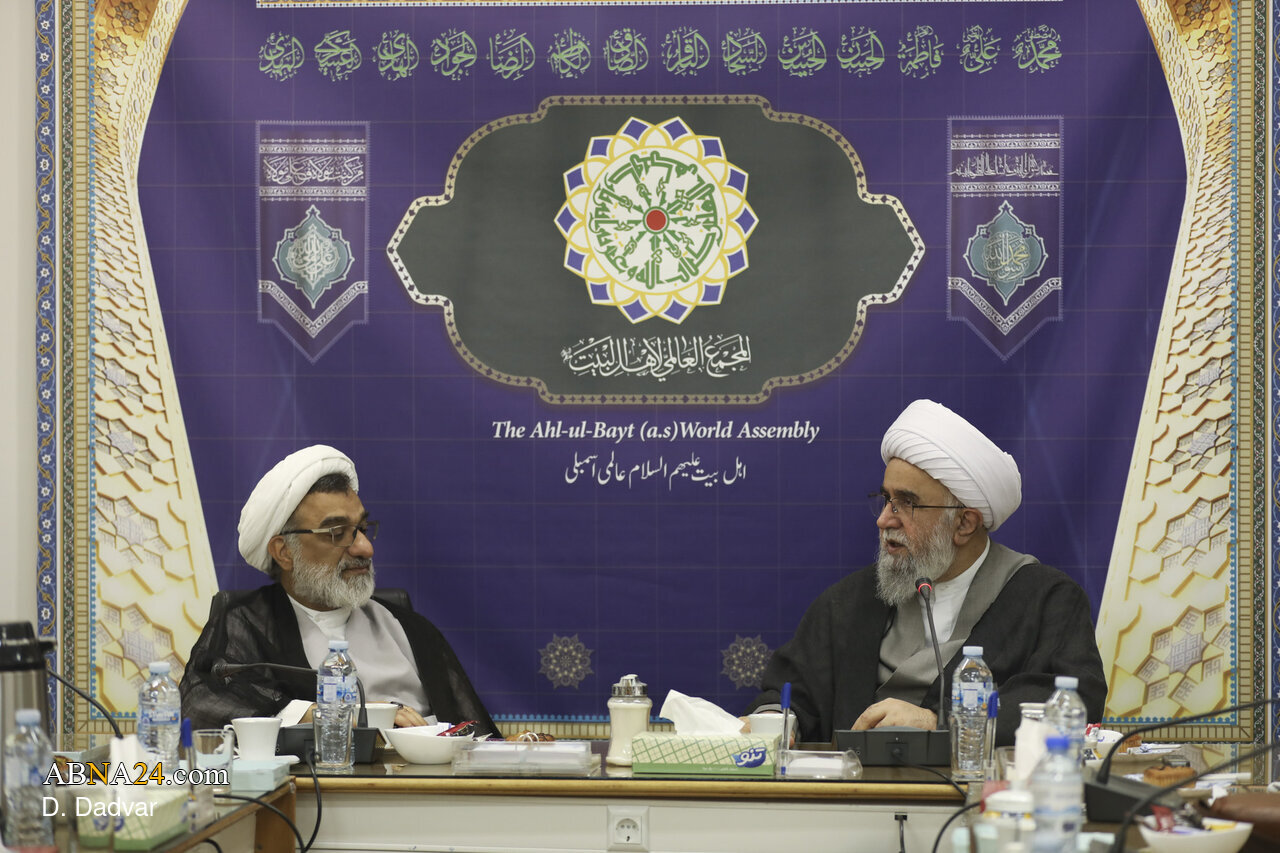
According to the AhlulBayt World Assembly News Portal: In a strategic meeting between Ayatollah Reza Ramazani, the Secretary-General of the AhlulBayt (a.s.) World Assembly, and Hojat al-Islam Abdul Hossein Khosropanah, the Secretary of the Supreme Council of the Cultural Revolution, the extensive dimensions and achievements of the Assembly in international, scientific, and media fields were examined.
Ayatollah Ramazani, at the beginning of this meeting held in the meeting hall of the AhlulBayt (a.s.) World Assembly, while expressing satisfaction with Hojat al-Islam Khosropanah’s presence at the Supreme Council of the Cultural Revolution, referred to his long-standing scientific and managerial background. He noted that Hojat al-Islam Khosropanah, prior to his new responsibility, was in charge of establishing the Deputy of Humanities at Islamic Azad University and was able to train more than 7,000 humanities professors in Islamic humanities courses without executive interference.
The Secretary-General of the AhlulBayt (a.s.) World Assembly also, recalling Khosropanah’s background as the head of the Iranian Research Institute of Philosophy and the Seminary Studies Center, emphasized the long-standing history of scientific communication between the two sides.
Referring to shared memories of attending advanced courses in Asfar and jurisprudence of Ayatollah Javadi Amoli, he considered these scientific sessions very fruitful and emphasized utilizing mutual capacities on the path of scientific transformation.
These conversations paved the way for presenting a comprehensive report on the performance of three decades of activity of the AhlulBayt (a.s.) World Assembly.
Ayatollah Ramazani stated that the Assembly, with a strong Supreme Council composed of the most prominent Shia leaders in the world, including figures such as the martyred Sayed Hassan Nasrallah, Sheikh Naim Qassem, Sayed Sajid Naqvi, and Sayed Ammar Hakim, alongside domestic individual and legal personalities, enjoys considerable capacity.
Also, the General Assembly of this institution currently includes about 700 Shia elites and activists from 120 countries around the world.
The Discourse-Building Network of Indigenous Missionaries and the Media Leap in ABNA and WikiShia
The Secretary-General of the AhlulBayt (a.s.) World Assembly, referring to the recent amendments to the Assembly’s statutes, announced a new approach to expanding communication with other Shia currents, including the Shias of Yemen and Ansarullah.
He considered one of the most important operational capacities of the Assembly to be the network of indigenous missionaries and announced that currently about 4,000 indigenous missionaries (including 1,100 missionaries in Africa) are active, and planning is underway to increase this number to 5,000.
The Secretary-General of the Assembly described examples of the field power of this indigenous network; including the holding of more than 10,000 commemoration sessions for Martyr Soleimani in India and a gathering of 200,000 people in Lahore, Pakistan, organized by these very popular capacities.
He emphasized that these forces are not dependent on administrative organizations and, as local elites, play a key role in the Assembly’s cultural and public diplomacy.
In continuation of this meeting, the Assembly’s media achievements were evaluated; the ABNA International News Agency, which was previously limited to 5 to 6 languages, now operates in 23 to 27 living languages of the world and provides extensive coverage of news from the Islamic world.
Also, the online encyclopedia WikiShia, by upgrading from 10 languages to 22 living languages and compiling more than 44,000 specialized entries, has become a reliable and supervised source for introducing Shia teachings, which has structural and content differences from secular encyclopedias.
The International Leap of the AhlulBayt (a.s.) University, Local Book Printing, and the Thaqalayn Network
Another part of the report was dedicated to the significant leap of the AhlulBayt (a.s.) International University; the diversity of nationalities of this university’s students has increased from 9 nationalities to 39 nationalities, and its student population has increased from 200 to 1,450 students at the master’s and doctoral levels.
This university has succeeded in obtaining the first rank in attracting foreign students in the country and has expanded its physical infrastructure from 4,000 square meters to more than 107,000 square meters.
In the field of publications, Ayatollah Ramazani referred to the printing of more than 2,000 book titles in 58 languages of the world and announced a change in printing strategy.
Based on this new approach, instead of printing books inside the country and sending them at high cost, the process of translation and printing is carried out in destination countries such as India and Russia for more effective distribution.
Also, the Thaqalayn International Network, as a 24-hour network in Arabic and Turkish languages, plays an important role in producing media content.
In continuation, a video documentary of the Assembly’s performance report titled “From Cultural Diplomacy to the Frontiers of Knowledge” was shown, indicating the production of more than 28,000 news items in ABNA, the broadcast of more than 813,000 minutes of programming on the Thaqalayn Network, the granting of 40 scholarship opportunities, the publication of 90 scientific articles, and the implementation of more than 180 educational projects in countries such as Pakistan, Afghanistan, and Yemen.
Also, the activities of the International Ashura Foundation were depicted with 580,000 views and the registration of 250 development projects.
Emphasis on Institutional Synergy, Skills Training, and Visiting the Achievements Exhibition
After the clip was shown, Hojat al-Islam wal-Muslimin Dr. Shakeri, the Scientific and Cultural Deputy of the Assembly, presented a report on field activities.
Recalling a memory of cooperation with the University of Delhi in India, he referred to the holding of the international conference “The Meaning of Life” and the explanation of the model of Imam Khomeini (r.a.) alongside the teaching of the Imam’s poetry collection at that university and considered it a successful example of scientific diplomacy.
He emphasized that the AhlulBayt (a.s.) World Assembly, with a popular approach, has high potential for synergy with other institutions, including the Supreme Council of the Cultural Revolution.
At the end of this meeting, Hojat al-Islam wal-Muslimin Khosropanah, praising the Assembly’s operational approach, emphasized the necessity of breaking administrative boundaries and realizing real synergy among the country’s cultural institutions.
The officials and those present at the meeting then visited the exhibition materializing the achievements of 37 years of the AhlulBayt (a.s.) World Assembly to become closely acquainted with the details of international and cultural projects.