



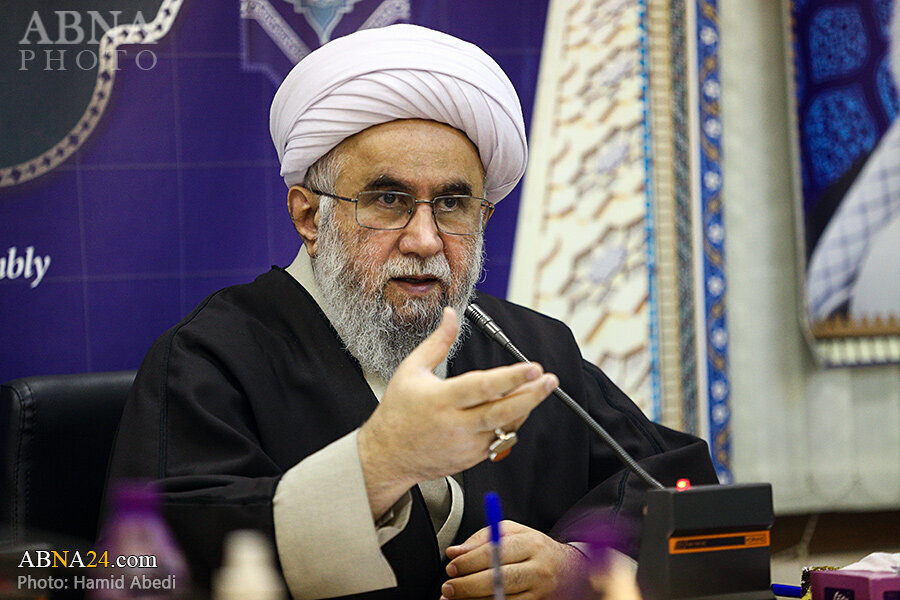
According to the AhlulBayt World Assembly News Portal: Ayatollah Ramazani, the Secretary-General of the AhlulBayt (a.s.) World Assembly, at the beginning of his advanced jurisprudence class in the new academic year, while praising God and sending blessings upon the Great Prophet (p.b.u.h.), stated, “We thank God Almighty for granting us the success to begin the class once again; ‘Whatever the Messenger has given you—take; and what he has forbidden you—refrain from.’ First, we must understand religion so that we become religious, and then, if success is granted, we may have a guiding role.”
The Mission of Religious Scholars; Propagation, Teaching, and Training
Ayatollah Ramazani, stating that religious scholars have received the positions of propagation, teaching, and training from the divine prophets, added, “Religious scholars have all received these positions from the divine prophets; the position of propagation, the position of teaching, and the position of training; they should be both propagators of religion, both teachers, and both trainers, and perhaps if they are purified, they can also be bearers of glad tidings and warnings and illuminating lamps.”
He stated, “Everyone, to the extent of the light and truth they have received, can play a role and step toward guiding society.”
All Prophets Sought to Form an Ummah
Referring to the issue of ummah-building in the history of religions, he stated, “You know that all prophets came to form an ummah, but this did not materialize. The Prophet of Islam formed this ummah, then events occurred. Disagreements and divisions caused dispersion among the Islamic ummah.”
Ayatollah Ramazani continued, “The enemies of Islam benefited from this dispersion and disagreement to their own advantage, and the ground for the plundering and humiliation of Muslims was created in this way. Many events occurred, many crimes occurred throughout the history of Muslim life, and how many Muslims were killed due to these disagreements.”
The Role of Colonialism in Creating Disagreement Among Muslims
The Secretary-General of the AhlulBayt (a.s.) World Assembly, referring to the history of colonialism, stated, “The colonial system exploited Muslim disagreements, and perhaps the origin of these disagreements was these very colonial systems? If you study the history of British colonialism, you will see that disagreements were created between Sunni and Shia and later among Sunnis themselves, followers of Sunnis, and among Shia followers themselves.”
He added, “In these recent decades, we have had the most victims among Muslims due to these very disagreements.”
Training and Awakening of the Ummah; Expansion Among Followers of Different Religions
Ayatollah Ramazani, referring to the performance of Imam Khomeini (r.a.) and the Leader of the Revolution in forming and training the Islamic ummah, stated, “Our Imam established this ummah after the revolution, because he believed in this ummah, that goal, and that path, and he worked for ten years to consolidate this ummah.”
He added, “The martyred Imam trained the ummah for 37 years on how a Muslim should live, changed our perspectives, and gave us a deep vision.”
The Secretary-General of the AhlulBayt (a.s.) World Assembly added, “This movement grew and expanded to the point that some non-Muslims also joined this ummah, and therefore you see that non-Muslims, from Christians, from Abrahamic religions and human religions, Hindus, Sikhs, they now come and say that we have many commonalities with you; we must use these commonalities for those lofty goals.”
Referring to the holding of commemorative gatherings for the martyred Leader and support for Iran in various countries, he said, “In Pakistan, some gatherings had more than 200,000 people present. The gatherings that were held in some countries had 30,000, 40,000, 50,000 people… one of those dozens of gatherings had this population.”
Ayatollah Ramazani stated, “After the martyrdom of the martyred Leader, a kind of awakening occurred; human consciences were awakened. Many people who thought they were on the right path realized they were on the wrong path, and after the martyrdom they realized that the right path was the path that our great Imam and martyred Imam guided us toward and placed us on the right side of history.”
The Necessity of Training Scholars of the Time in Seminaries
Ayatollah Ramazani, referring to the new conditions, said, “According to what happened, the seminary’s duty is heavier in the field of teaching and training; the seminary institution must have the most prominent role in training scholars of the time.”
He added, “Scholars of the time who, when faced with attacks, can stand against the attacks and confront them. This is a point mentioned in narrations: ‘The one who is aware of his time, confusions do not attack him’; and therefore the duty becomes heavier.”
“Unprecedented” Conditions for Propagating Islam
The Secretary-General of the AhlulBayt (a.s.) World Assembly described the current world conditions as “unprecedented for propagating Islam” and said, “Our conditions today are unprecedented conditions for propagating Islam; given the needs of the day, given the crises. We are facing intellectual, moral, and practical crises in the world.”
He continued, “Those who claimed enlightenment and determining the path themselves faced crises; in the field of thought and thinking, in the discussion of family, in the discussion of education, and the like, they faced crises.”
The Necessity of Strengthening the Propagation Institution and Paying Attention to Propagation Skills
Ayatollah Ramazani stated, “Therefore, today the propagation institution within the clergy must be strengthened as the first priority.”
Explaining the concept of propagation, he said, “Of course, the propagation we speak of is in the general sense of the word, not those who only go for Muharram and Safar and Ramadan and such; it is in the general sense of the word; propagation of Islam, propagation of the Quran, propagation of revelation, propagation of religion as the greatest divine trust.”
He added, “This meaning of propagation includes the source of emulation (Marja’), the great figures of the seminary, preachers who go on the pulpit and give sermons and lectures, Friday prayer leaders, congregational prayer leaders; all those who strive in this field are included.”
Ayatollah Ramazani emphasized, “Paying attention to the conditions of propagation, matters such as audience recognition, subject recognition, need recognition, necessities and priorities for the matter of propagation, skill recognition, and various skills are important.”
He considered skill in various fields as among the important needs of propagation and said, “Skill in pulpit speaking, in classroom teaching, in question and answer, in responding to doubts, in correctly explaining rulings, the teachings of the Quran, the merits of the words of the AhlulBayt, speaking appropriately and speaking in a localized manner; these are important needs that must be attended to.”
The Five Stages from the Islamic Revolution to Islamic Civilization
The Secretary-General of the AhlulBayt (a.s.) World Assembly then addressed the seminary’s connection with the Islamic system and said, “Attention to the elevation of the Islamic system is among the points that we seminarians must pay attention to; of course, some say in this regard that it is not very related to us; whereas this category has a close connection with seminary affairs: the Islamic system.”
He added, “Of course, we have not yet reached many of the goals we must reach; that all Islamic rulings be implemented in society, that justice in the true sense be implemented in society, that the rights of individuals in society be implemented, that relative welfare, for example, be created.”
Ayatollah Ramazani continued, “The martyred Imam presented the stages: Islamic Revolution, Islamic System, Islamic State, Islamic Society, and Islamic Civilization. We are still on this path, and costs have been paid for each.”
The Costs of the Revolution and the Formation of the Islamic System
Regarding the costs of the Islamic Revolution, he stated, “For the revolution and the occurrence of the revolution, about 70 percent of the people participated, which was unprecedented or rare in the world. We paid many costs. Great scholars were in prisons, were exiled, our youth were martyred.”
Ayatollah Ramazani also said about the formation of the Islamic System, “The Islamic System endured many bitter experiences for its formation; including this very imposed war, meaning the eight-year war that we defended. We also had the Sacred Defense. We were not aggressors; we were defenders against the aggression that occurred.”
The Role of the Clergy in the Sacred Defense and the Assassinations of the Early Years of the Revolution
The Secretary-General of the AhlulBayt (a.s.) World Assembly, referring to the seminary’s role in the Sacred Defense, said, “The seminary also had a great role; in this Sacred Defense, in proportion to the population of clerics, the most martyrs were from the clergy; being at the forefront, being a pioneer, being a driver is a component of the revolutionary seminary.”
He added, “In the discussion of assassinations, the greatest martyrs of assassination were from the clerics. The martyrs of the mihrab and countless other martyrs from the clergy community were offered to the revolution.”
Ayatollah Ramazani, referring to the assassinations of the early years of the revolution, stated, “A large number of people and clerics were assassinated in the early years of the revolution.”
The Responsibility of the Islamic State Toward Society’s Morality
Ayatollah Ramazani continued, “The state must become Islamic. The duty of the state; when we say state, it is not only the executive branch. The Islamic state and government must have concern for Islam.”
He stated, “It cannot say I have no responsibility for people’s heaven and hell. The Islamic state has responsibility; it must provide the ground.”
The Secretary-General of the AhlulBayt (a.s.) World Assembly added, “Of course, everyone chooses religion by their own choice, but it must prevent corruption, prevent nudity, prevent indecency. This is the enemy’s plan in the hybrid war.”
He continued, “Regarding the hijab, all relevant institutions are obligated to realize the conditions and grounds for promoting this important matter. More than 30 institutions have legal responsibility in this regard. The clergy is obligated. University officials are obligated, because nudity’s end is departure from that path of felicity.”
Warning About the Andalus Experience and the Consequences of Prostitution and Nudity
Ayatollah Ramazani, referring to the historical experience of Andalusia, stated, “In Andalusia, where Islamic rule was established for 600, 700 years, due to this very prostitution, indecencies, nudity, and this indecency, those serious deviations emerged.”
Citing the words of Amir al-Mu’minin (a.s.) in Nahj al-Balaghah, he stated, “The Islamic state, according to the explicit expression of Amir al-Mu’minin in Nahj al-Balaghah, has a duty and obligation toward the rulings of Islam and the teachings of Islam.”
The Islamic Country and the Responsibility of the Nation
The Secretary-General of the AhlulBayt (a.s.) World Assembly then described the stage of “Islamic Society” and said, “The next stage becomes Islamic society; meaning every alley, street, market, and wherever you go, you must see the symbol of Islam there. The country must be Islamic, not just the Islamic state.”
He added, “The nation must also be an Islamic nation, and the rules of Islam and the standards of Islam must be observed in it.”
Ayatollah Ramazani also said about the issue of crime, “Of course, it does not mean that, for example, theft does not occur; it does not mean that in that system theft is never possible; no. If there is theft, the Islamic system prevents it.”
He stated, “The Islamic government, when implemented, prevents criminals. A criminal is not safe in an Islamic system.”
Iran, Independence, and 47 Years of Pressure and Sanctions
Ayatollah Ramazani continued his remarks, stating, “Ultimately, to preserve this independence, freedom, and liberation from the yoke of colonialism and exploitation, many costs have been paid in these 47 years.”
He added, “For 47 years, they have carried out all kinds of conspiracies against the Islamic Republic; all kinds of threats, all kinds of sanctions, all kinds of humiliations, insults, and finally calls for surrender. All of these were carried out.”
Reference to Iran’s History and the Plundering of Resources
The Secretary-General of the AhlulBayt (a.s.) World Assembly, referring to Iran’s history, stated, “Islamic Iran is an ancient country with a very long history. Of course, there were incompetent officials in different periods that both the geography of the Islamic country shrank and those advancements that existed in Islamic Iran decreased in quality.”
Regarding Iran’s relationship with Islam, he said, “After the arrival of Islam, the mutual services between Iran and Islam caused the scientific and faith elevation of Iran. Iran became Islamic.”
Ayatollah Ramazani then referred to the scientific history of Iran and the Islamic world and said, “Figures like Ibn Sina, Zakariya Razi; these were ultimately great figures of the Islamic world.”
He continued, “These conspiracies always continued, and they always sought to plunder a wealthy Iran, and this indeed happened. They plundered a wealthy Iran and stole the wealth that existed in Islamic Iran.”
Explaining the “Theory of Resistance” as a Quranic Teaching
Ayatollah Ramazani, emphasizing the necessity of explaining the “theory of resistance,” said, “Today we are facing an ummah-building that we must appreciate. These two important sentences must be attended to. First, we must correctly explain the theory of resistance from verses and narrations.”
He warned, “Some seek to remove jihad and resistance from the system of religious thought. We must be careful. The theory of resistance is one of the most important Quranic teachings against the system of domination.”
Ayatollah Ramazani, citing the verse “Muhammad is the Messenger of God, and those with him are severe against the disbelievers and merciful among themselves,” stated, “The followers of the Prophet must train themselves in this way.”
“We Will Never Hold a Referendum for the Continuation of Defense”
The Secretary-General of the AhlulBayt (a.s.) World Assembly, referring to the wars waged against Iran, said, “They attacked us, committed aggression, imposed it three times; one time it lasted eight years, one time 12 days, by their own account the largest army in the Middle East attacks Iran. They never thought Iran would resist like this.”
Ayatollah Ramazani, in another part of his remarks, rejecting the proposal of a referendum for the continuation of defense, stated, “We will never hold a referendum for the continuation of defense; never. They never held a referendum for the continuation of aggression!”
He added, “Did America hold a referendum for the continuation of its aggression? America, which considers itself the most democratic country in the world, which today is the most despotic country in the world? Did it hold a referendum for the continuation of its aggression?”
“Defense Is Our Legitimate Right”
Ayatollah Ramazani stated, “Should we hold a referendum for defense? What kind of literature is this? Defense is our legitimate right. Defense is by the command of reason and nature. The practice of the wise everywhere dictates that a human must defend himself; he must defend his honor, his country, his entire possessions in his country.”
Criticizing what he called creating division in society, he stated, “Unfortunately, some utter these phrases and create division in society.”
He added, “Whereas today is the time when we most need unity and solidarity, which our martyred Imam called sacred unity.”
Emphasis on Creating Hope and the Clergy’s Duty
The Secretary-General of the AhlulBayt (a.s.) World Assembly said, “Our duty today is to give people hope with a divine vision; although they have inflicted great damages on us; material damages, spiritual damages.”
He added, “Spiritual damages, which of course can never be compensated, they have inflicted these damages on us. We are in such conditions. We cannot be indifferent to this set of conditions.”
Ayatollah Ramazani stated, “Our negligence will lead to divine accountability, and that will be the unforgivable sin.”
Yemen and the Resistance Front
Ayatollah Ramazani, in the concluding part of this section of his remarks, said, “Today we are facing the great phenomenon of the Yemenis; these mujahideen in the path of God who resisted against the adversary and stood firm and are securing their rights.”
He added, “Today the resistance front is growing stronger day by day; because in this resistance front, the body of the world’s nations has been placed. When the body of the world’s nations has strong wills, this will be invincible.”
Ayatollah Ramazani, in summarizing this section and before entering the main topic of the advanced jurisprudence class, emphasized, “The seminary, while it must give prosperity to its lessons and discussions, must also attend to this important duty.”