

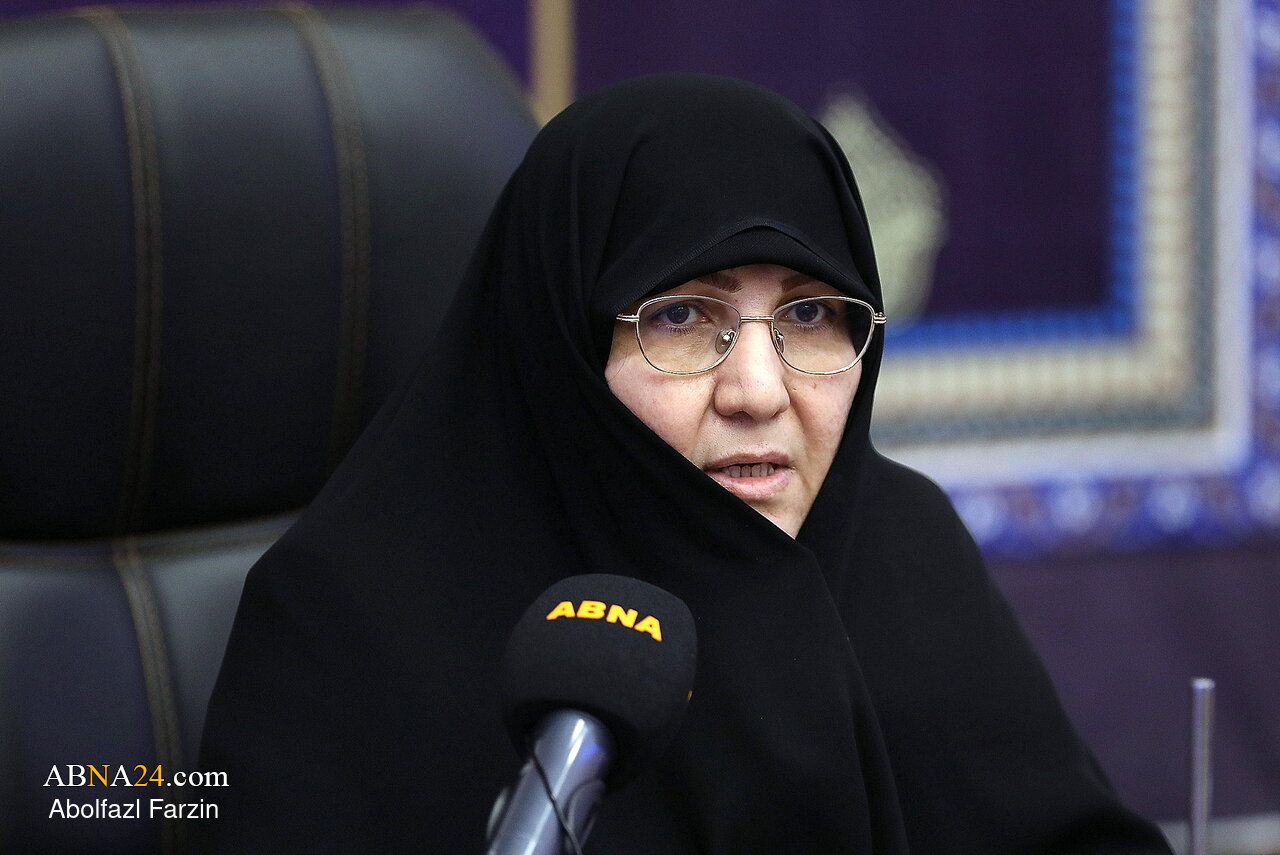
According to the AhlulBayt World Assembly News Portal: Speaking at a specialized gathering titled: “Woman of Resistance: Architect of Culture and Identity”, Dr. Al-Asvand, a professor at seminary and university, exposed what she described as the new dimensions of the neo-Orientalism project and efforts by international institutions to impose fluid concepts such as gender. The event was held at the assembly hall of the World Assembly of Ahlul Bayt (AS) and organized by the General Directorate for Women and Family of the Assembly’s international affairs department, with participation from women activists and members of the Iraqi sisters’ delegation Liwa al-Kawthar.
Dr. Al-Asvand said the question of women has remained the central axis of Orientalism from the past to the present, noting that Western Orientalism rests on a structure of othering in which the white European considers himself the center of the world and the original text while regarding other societies and cultures as marginal. She pointed to a printing line and the widespread publication of Western books and articles against Islamic societies, saying this school of thought seeks to distort the history of Islam and countries such as Iran and claim that homosexual relations existed in the history of Islamic societies and that their religious prohibition entered Islam only after the Crusades and under Christian influence. She described this as a ridiculous claim and an intelligent strategy for manufacturing history in Islamic societies.
Explaining the concept of neo-Orientalism based on the views of Edward Said, she noted that unlike traditional Orientalism, which portrayed the Eastern woman as passive, illiterate, and backward, the new Orientalism insists that the Muslim woman must introduce her identity, authenticity, and religious rulings, including hijab as the garment of social presence and vitality, to the West with a new understanding, because Westerners lack a correct understanding even of the simplest behaviors of Muslim women, such as wearing hijab at home or in society.
On the engineering of international terminology, Dr. Al-Asvand said the West’s main skill is creating new concepts and injecting them into the international space and Islamic societies in order to change the roots of Muslim life. She said the concept of gender justice in Western documents and readings has no connection to the original concept of justice. The West began with removing obstacles and creating equal opportunities, she said, but in the 1980s, having failed to achieve its goals, it moved toward equality of outcomes and state intervention to favor women’s rights over men’s.
She noted intelligent lexical changes in international treaties, saying the West first removed the humanizing words man and woman, which carry moral weight and family commitment in sacred texts, and replaced them with the biological terms male and female in order to remove the moral dimension of relationships. Then, by substituting the fluid term gender, it erased all natural boundaries. She revealed that after the year 2000, the term gender came to cover all dimensions of homosexuality and sexual deviation, and that the dominance of these concepts has reached the point where at international gatherings, including in Geneva, Switzerland, United Nations representatives formally interrogate delegations from Islamic countries about when and how they will legalize homosexuality in their laws.
Turning to the dimensions of the woman of resistance, Dr. Al-Asvand stressed that confrontation in the resistance line is not merely a military tool. The main weapon of the Muslim woman, she said, is entering the academic arena, mastering modern sciences and international treaties to confront Western pseudo-science. Western media and academic apparatuses turn deep theories into ordinary behaviors and social norms, she said, and we must stand against this process.
She pointed to purity movements in the West, saying large social and academic currents among Christians and Jews defending the family have formed around the culture of purity, because they consider purity and impurity to be civilizational matters, something the Holy Quran also emphasizes as a networked matter in society.
Dr. Al-Asvand outlined the dimensions of the victim woman, the demanding language, and the woman as narrator. She said poverty and war have feminine dimensions and that women in wars bear a multiplied burden of suffering, fearing for themselves and their children. Unfortunately, she said, in human history and recent wars such as those in Bosnia and Chechnya, sexual assault has been used as a war strategy for ethnic cleansing and humiliating societies.
She stressed that the position of Islamic societies must change from defensive to offensive, saying that as the martyr Sayyed Abbas al-Musawi emphasized, our language before the West must not be the language of pleading and begging, but the language of assault, trial, and demand. She stressed the vital necessity of the woman as narrator, saying that if we do not narrate our story of resistance and capability, no one will narrate it for us in history.
Citing concrete examples of resistant women in Iran and Gaza, she said the steadfastness of the wives of martyrs in Iran, who despite holding advanced university degrees and expertise take pride in their hijab and have transcended the attachments of the self, as well as the women of Gaza who recite the Quran among the bodies of martyrs, have created a wave of astonishment and questioning about the Quranic roots of resistance in world public opinion and social networks.
Criticizing Western educational policies built on paralyzing the spirit of resistance, extreme welfareism, and creating absolute ease for children, Dr. Al-Asvand said that in Islamic philosophy, hardship and difficulty are an important element in human upbringing, because preserving hijab, prayer, and religious rules requires spiritual fortitude.
In conclusion, she posed a key question to the Islamic community, saying we must determine our position on whether we want to raise heroes in our midst. Raising a resistant generation committed to principles, she said, requires educational methods based on strengthening spiritual fortitude and moving beyond extreme welfareism.